Shaping the machine that shapes itself
July 20, 2026

Every conversation about a local model's capabilities ends the same way. A discussion about their novelty, their attempts at imitating a frontier model, a "but maybe one day" added as a foot note. None of that is wrong. It's just dispensation.
Hand a 9B model a bare chat window. Tell it to write to files with no guardrails. It will absolutely make a mess. But maybe that isn't a flaw with the model, maybe it was the tools and harness it was given. I wanted to find out how much of the gap actually closes if you build the harness and the tools properly, letting the model excel, instead of sticking it in a barren room and asking it to paint the Mona Lisa.
So I built reso: a local, agentic CLI that runs entirely on open weights. Same shape as Claude Code, Antigravity, or Codex: sitting in a terminal, reading and writing files, running commands, calling tools, all of it. Just with a small, local model on the other end instead of a frontier one.
How far could I take a local model, on consumer-grade hardware? This was never a question of how closely I could imitate frontier models, it was a question of what capabilities could I give myself to keep. Free, local, open-weight, and private.
Capable of rewriting itself
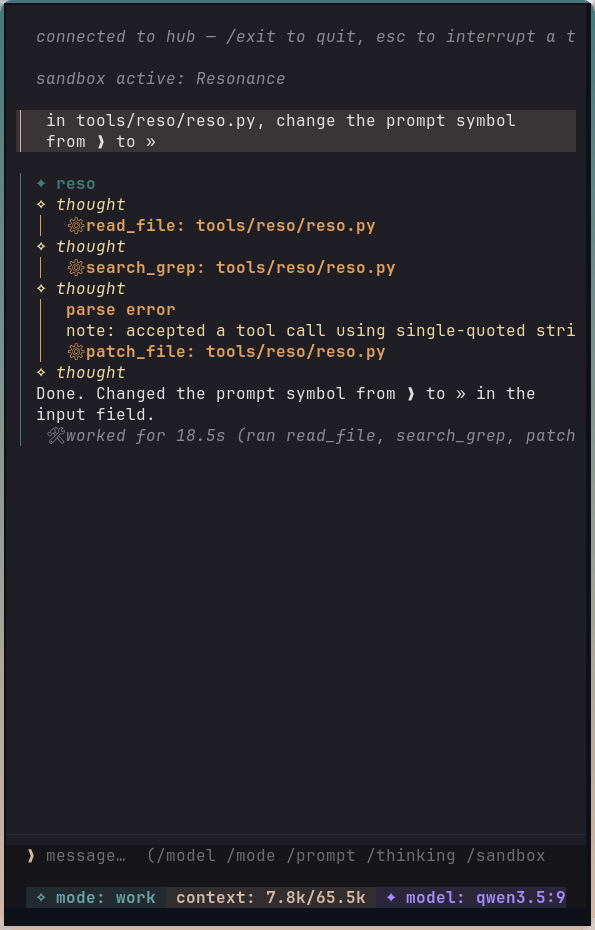
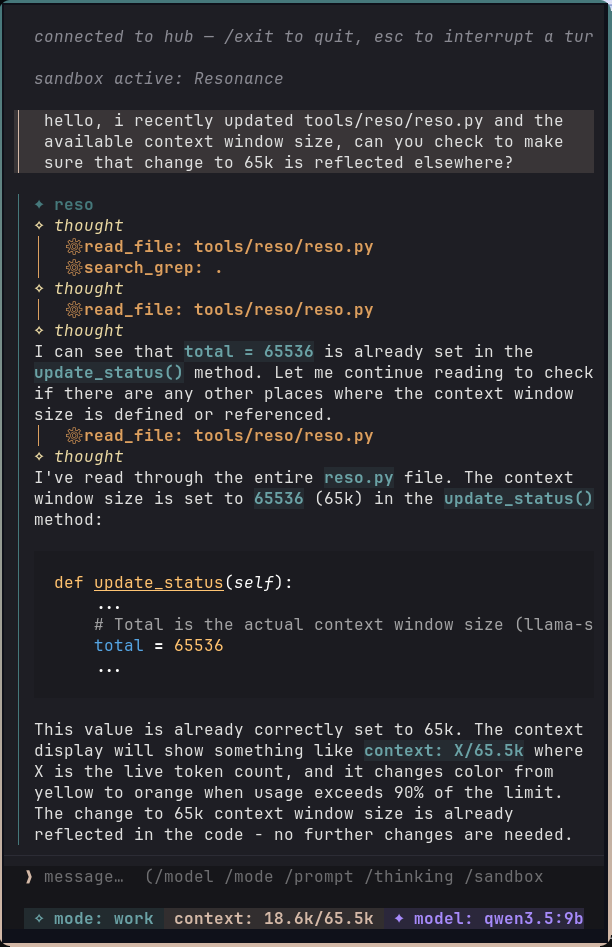
The first real task I gave reso was to add a live context-token counter to its own status bar, replacing a static label. It took noticeably longer than Claude or any frontier model would have: more file reads, more back-and-forth, a couple of malformed tool calls it had to re-emit before getting the JSON right. I let it keep going instead of stepping in.
What came back wasn't just the counter I asked for. Reso also decided, on its own, that the counter should turn a warning orange once the context window crosses 90% full, a feature I never specified. That's the whole thesis in one session: a tool built by a model, extending itself, adding a capability nobody asked for because it understood the intent behind the request and not just the literal spec. It's not a huge leap, it's a status label changing color, but it's the kind of thing that makes a system feel like it's starting to build itself rather than just being built.
A small consortium of robots
Reso doesn't work alone; it's the newest member of a small lineup of AI CLIs I run, each slotted into a role based on what it's actually good at rather than what's newest:
- Claude (anthropic-sonnet) — the senior dev. Leads, gets the ambiguous or high-stakes work.
- Agy (google-gemini) — the specialist. Logic, GUI work, refactoring.
- Kimi (moonshot-k3) — the experiment, a newer Chinese model I'm still evaluating.
- Codex (openai-sol) — competent, but insufferable to talk to; boring enough that I stopped reaching for it.
- reso (me-qwen3.5) — the intern dev. Local, open, and pulling up the rear on purpose.
Reso's job isn't to outperform the rest of the consortium. It's to handle everything it can handle within its own limitations, and hand off to something bigger only for the work that actually needs it. Different tools for different jobs isn't just a line about reso's toolset, it's how I decide which CLI opens for a given task in the first place.
Scalpel not a butcher's knife
Changing a label's color, tweaking a value, a small isolated edit: sending that to a frontier model is like taking an F1 car to the grocery store. It'll get there, but you paid for a level of capability the trip never needed. Reso exists for that whole category of work, and for the harder question behind it: open models don't suck, they just need a good harness and toolset to excel in one.
That's also why performance was never the metric I judged reso against. Local and open already wins on its own terms, before a single benchmark runs, because it's mine, it's on my hardware, and nothing about it depends on somebody else's API staying up or staying priced the way it is today. Whether reso one-shots a task or grinds through it over several tool calls doesn't change that. After a day of real use I still don't know where its ceiling actually is, because finding it requires me to scope work correctly, the same way you'd scope a task for a junior developer instead of just repeating it louder.
Stacking the odds in its favor
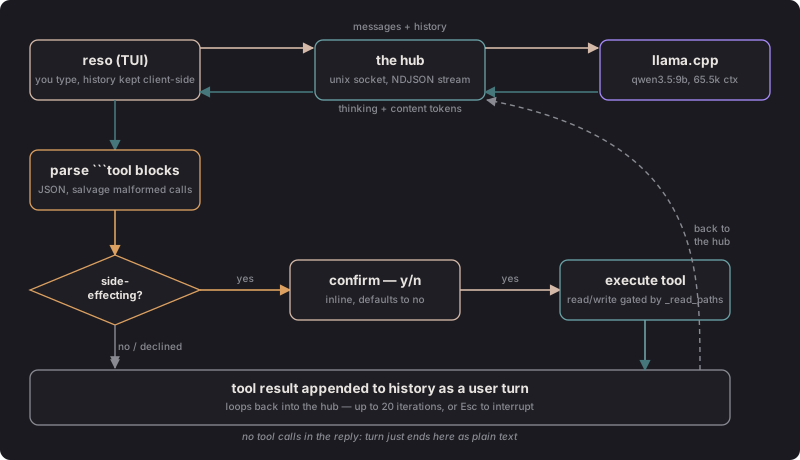
This is the part that actually had to be engineered. Reso talks to qwen3.5:9b
over a Unix socket (/tmp/resonance-hub.sock) to a shared component I call
the hub, which fronts llama.cpp and streams NDJSON chunks back: thinking
tokens and content tokens, distinguished, so reso can render them
differently while they arrive. The context window is 65,536 tokens
(llama-server --ctx-size), tracked live in the status bar and colored
orange past 90% full, the same feature from the anecdote above.
Three modes, switched with /mode:
| Mode | Tools available | Purpose |
|---|---|---|
chat | none | pure conversation, no tool blocks accepted |
discuss | read-only (read_file, find_files, view_tree, search_grep, list_dir, web_search, read_webpage) | brainstorm and inspect without touching anything |
work | all 20 tools | the agent mode, full read/write/shell access |
20 tools total, split roughly into:
- Shell:
run_command, a 30-second-capped shell call in the launch directory. The system prompt deliberately steers reso away from using it to read or edit files (shell quoting of quotes/backslashes/!is fragile for a small model to get right) and reserves it for what actually needs a shell: running programs, checking process or service status. - File ops:
read_file,write_file,append_file,patch_file,rename_symbol,move_path,copy_path,delete_path,make_directory,make_executable,get_path_info - Navigation:
change_dir,list_dir,find_files,view_tree,search_grep(matches report a byte offset, so a hit can be jumped to directly withread_file(path, offset=N)instead of paging from the top) - Web:
web_search(Brave Search API, with a DuckDuckGo Lite fallback),read_webpage - Verification:
browser_check, which loads local HTML in headless Firefox via Selenium and runs JS against it, so reso can confirm a fix actually works in a real DOM instead of reasoning about it from the diff
Protecting us both from itself
Ten of those are in SIDE_EFFECTING and require an inline y/n confirmation
before they run, focus defaulting to "no." The rest of the guardrails are
what make "scalpel, not butcher's knife" a literal design constraint rather
than a metaphor:
write_file,patch_file,append_file,delete_path, andmake_executableall refuse to touch a file that wasn'tread_file'd first, in that same session. Reso can't blindly edit or delete something it hasn't actually looked at.rename_symbolexists as its own tool, separate frompatch_file, specifically becausepatch_fileonly rewrites the exact block it's given; a rename needs every occurrence updated atomically in one write, or it silently leaves stale references behind.- Every path tool resolves through
os.path.commonpathagainst the directory reso was launched from. Anything outside it is a hard refusal. Toggleable with/sandbox, on by default. - A hard cap of 20 tool-call iterations per turn, and
Escinterrupts mid-turn: kills the streaming socket, cancels the running tool worker, stops the reveal timer. No waiting out a model that's spiraling. - Streamed output is capped at 20,000 characters as a last line of defense against a runaway generation loop.
The system prompt does real work here too, not just the tool list: it
explicitly tells reso to prefer patch_file over rewriting a whole file, to
use rename_symbol instead of patch_file for renames, to clean up dead
code it makes obsolete instead of leaving it behind, and to never claim a
task is done in the same turn it emits the tool calls for it, only after
the results actually come back. Small models follow explicit process
instructions like these far more reliably than they infer good practice on
their own; that instruction set is as much a part of "the harness" as the
sandboxing is.
The honest caveats
Reso doesn't clean up after itself the way a smarter model reliably does. The system prompt tells it to remove code it's made obsolete, but there's no enforcement behind that instruction. It may create new bugs during the process of removing old ones, or simply spiral and corrupt a script. There is no way I've found, to give the model intelligence it doesn't already possess. No matter how good an intern can be, checking their work is still a part of the process.
What I wanted out of this, wasn't a free and local frontier model. What I wanted was to own my tools, not borrow them. That leaves a more difficult and sobering thought to turn to. The day of companies and research groups releasing an 8B or 14B model seems to be coming to an end. I don't know if we'll see another "Qwen" be released, powerful and capable, able to run on consumer hardware.
But maybe one day.
Code to be uploaded to GitHub